Noco Genius Charger Manual: A Comprehensive Guide
Welcome! This detailed manual provides essential instructions for safely and effectively utilizing your NOCO Genius charger, maximizing battery life and performance.
The NOCO Genius line of battery chargers represents a significant advancement in battery maintenance technology. Designed for versatility, these chargers cater to a wide range of 12-volt lead-acid, AGM, and lithium-ion batteries, commonly found in vehicles, motorcycles, boats, and more.
Unlike traditional chargers, the Genius series utilizes a multi-stage charging process, intelligently adapting to the battery’s specific needs. This ensures optimal charging speed, prevents overcharging, and maximizes battery lifespan.
Featuring advanced safety mechanisms, including reverse polarity protection and spark-proof technology, the NOCO Genius provides a safe and user-friendly charging experience. This manual will guide you through the features, operation, and safety precautions necessary to get the most out of your NOCO Genius charger, ensuring reliable performance for years to come.
Understanding the Different NOCO Genius Charger Models
NOCO offers a range of Genius chargers, each designed to meet specific charging needs. The key difference between models lies in their amperage output, which dictates the size and number of batteries they can effectively charge.
Lower amperage models, like the GENIUS10, are ideal for smaller batteries found in motorcycles, ATVs, and personal watercraft. Stepping up to the GENIUS20 provides increased power for cars, trucks, and SUVs.
For larger vehicles, boats with multiple batteries, or demanding applications, the GENIUS35 and GENIUS50 offer even greater charging capacity. Choosing the right model ensures efficient charging and prevents overloading the battery or the charger itself. Consider your typical battery size and charging requirements when selecting a NOCO Genius charger.
GENIUS10

The GENIUS10 is a versatile, 10-amp, 6-volt and 12-volt smart battery charger and maintainer. It’s a popular choice for maintaining batteries in motorcycles, ATVs, snowmobiles, cars, and small trucks. Its compact size and lightweight design make it easily portable and convenient for various applications.
This model features multiple charging modes, including standard, AGM, Gel, and Lithium-Ion, ensuring compatibility with a wide range of battery types. It also incorporates advanced safety features like reverse polarity protection, short circuit protection, and over-temperature protection.
The GENIUS10 is capable of desulfating batteries, extending their lifespan, and recovering deeply discharged batteries. Its intuitive LED indicators clearly display the charging status and any potential errors.
GENIUS20
The GENIUS20 is a robust, 20-amp, 6-volt and 12-volt smart battery charger and maintainer, designed for larger vehicles and more demanding applications. It’s ideal for cars, trucks, SUVs, boats, and even RVs. Offering increased charging power compared to the GENIUS10, it significantly reduces charging times for depleted batteries.
Like the GENIUS10, the GENIUS20 boasts multiple charging modes – Standard, AGM, Gel, and Lithium-Ion – providing versatility for various battery chemistries. It includes comprehensive safety features, such as reverse polarity protection, spark-proof technology, and over-temperature protection, ensuring safe operation.
This model also features a battery desulfation mode to help restore sulfated batteries and extend their overall life. Clear LED indicators provide real-time charging status and error notifications.
GENIUS35
The GENIUS35 represents a significant step up in charging power, delivering 35 amps of 6-volt and 12-volt charging capability. This model is perfectly suited for larger vehicles like heavy-duty trucks, commercial vehicles, and equipment with substantial battery banks. It excels at quickly reviving deeply discharged batteries.
Maintaining the intelligent features of the GENIUS line, the GENIUS35 offers selectable charging modes for Standard, AGM, Gel, and Lithium-Ion batteries, ensuring optimal charging profiles for each chemistry. Advanced safety features, including reverse polarity protection and spark-proof operation, are standard.
Beyond charging, the GENIUS35 incorporates a battery desulfation function to recover sulfated batteries and prolong their lifespan. Its intuitive LED indicators clearly display charging progress and any potential issues.
GENIUS50
The GENIUS50 is the most powerful charger in the NOCO Genius family, boasting an impressive 50 amps of 6-volt and 12-volt charging power. This robust model is ideal for extremely large batteries found in commercial fleets, construction equipment, and agricultural machinery, offering the fastest possible recharge times.
Like its counterparts, the GENIUS50 retains the intelligent charging modes – Standard, AGM, Gel, and Lithium-Ion – adapting to various battery types for optimal performance and longevity. It’s equipped with advanced safety features like reverse polarity protection, spark-proof technology, and over-temperature protection.
The GENIUS50 also includes a dedicated “Force Mode” for charging deeply discharged batteries that other chargers might reject, and a battery recovery mode to attempt revitalization. Clear LED indicators provide real-time charging status.
Safety Precautions & Warnings
Important Safety Information: Always prioritize safety when using the NOCO Genius charger. Read all instructions before operation. Never charge a damaged battery; inspect for cracks or leaks. Ensure adequate ventilation during charging – batteries release explosive gases.
Avoid charging in enclosed spaces. Keep sparks, flames, and smoking materials away from the battery. Wear appropriate eye protection (safety glasses) and gloves. Do not disassemble the charger.
This charger is intended for 6V and 12V lead-acid, AGM, and lithium-ion batteries only. Misuse can result in battery explosion, fire, or personal injury. Disconnect the charger before connecting or disconnecting the battery. Never touch the charger’s terminals while it’s connected to AC power.
Package Contents & Identifying Components
What’s in the Box: Your NOCO Genius charger package should include the charger unit itself, a set of alligator clips for quick battery connections, and a pair of ring terminals for a more permanent installation.
Additionally, you’ll find this user manual containing important safety information and operating instructions. Carefully unpack all components and verify everything is present.
Identifying the Components: The charger unit features LED indicators to display charging status. The alligator clips have a color-coded system – red for positive (+) and black for negative (-). Ring terminals are designed to be securely fastened to the battery posts. Familiarize yourself with each component before proceeding with setup.
Charger Unit
Overview: The NOCO Genius charger unit is a compact, yet robust, device designed for versatile battery charging. Its casing is typically made of durable plastic, protecting the internal circuitry from dust and minor impacts.
Key Features: The front panel houses multiple LED indicators, each representing a specific charging stage or error condition. A DC output cable extends from the unit, terminating in connectors for the alligator clips or ring terminals.
Ports & Controls: Locate the DC output port for connecting to the battery. Some models may include a USB port for charging mobile devices. The unit is designed for automatic operation, requiring minimal user intervention beyond initial connection and mode selection.
Alligator Clips
Description: The included alligator clips provide a quick and convenient method for connecting the NOCO Genius charger to a battery. These clips feature a spring-loaded mechanism, ensuring a firm grip on the battery terminals.
Usage: Attach the red clip to the positive (+) terminal and the black clip to the negative (-) terminal. Ensure a secure connection to prevent sparking or inefficient charging. Avoid clamping onto painted surfaces or corroded areas.
Safety Considerations: Always inspect the clips for damage before each use. Replace any clips with frayed wires or broken springs. When disconnecting, pull from the clip itself, not the cable, to avoid strain. Proper connection is vital for safe and effective charging.

Ring Terminals
Description: Ring terminals offer a more permanent and secure connection to the battery compared to alligator clips. They are designed to be bolted directly onto the battery terminals, providing a robust electrical contact.
Installation: Loosen the nut on the battery terminal, slide the ring terminal onto the post, and securely tighten the nut. Ensure a clean, corrosion-free surface for optimal conductivity. Proper crimping of the wire to the terminal is crucial.
Benefits: Ring terminals minimize the risk of accidental disconnection and provide a lower resistance connection, potentially improving charging efficiency. They are ideal for vehicles or applications where the charger is frequently connected. Always double-check polarity before connecting.
Charging Modes Explained

NOCO Genius chargers feature multiple charging modes to accommodate various battery types, ensuring optimal charging and preventing damage. Selecting the correct mode is vital for battery health and longevity.
Mode Selection: Most models allow cycling through modes via a button press. The LED indicators will display the selected mode. Refer to your specific model’s instructions for details.
Automatic Mode: Many chargers have an automatic mode that detects the battery type and adjusts the charging process accordingly. However, manual selection is recommended for best results. Understanding each mode – Standard, AGM, Gel, and Lithium-Ion – is key to effective charging.
Standard Charging Mode
Standard Charging Mode is designed for traditional flooded lead-acid batteries – the most common type found in cars, trucks, and motorcycles. This mode delivers a consistent charge, carefully managing voltage and current to avoid overcharging or undercharging.
Charging Process: The charger initiates with a bulk charge, providing maximum current until the battery reaches approximately 80% capacity. It then transitions to an absorption phase, maintaining a constant voltage while current decreases. Finally, a float phase maintains the battery at full charge without damaging it.
Ideal For: Wet cell batteries that haven’t been specifically designated as AGM or Gel. Using this mode on incompatible battery types may reduce performance or lifespan.
AGM Charging Mode
AGM Charging Mode is specifically tailored for Absorbed Glass Mat (AGM) batteries, commonly found in modern vehicles, UPS systems, and marine applications. AGM batteries require a different charging profile than traditional flooded batteries due to their sealed construction and unique electrolyte absorption.
Charging Process: This mode utilizes a specialized charging algorithm that accounts for the lower gas output of AGM batteries. It features a controlled bulk, absorption, and float phase, optimized to maximize the lifespan and performance of AGM batteries.
Important Note: Selecting AGM mode for a standard flooded battery can lead to undercharging. Always verify your battery type before selecting a charging mode for optimal results.
Gel Charging Mode
Gel Charging Mode is designed for Gel batteries, a type of sealed lead-acid battery utilizing a gelled electrolyte. These batteries are known for their durability and vibration resistance, making them ideal for demanding applications like off-grid systems and mobility scooters.
Charging Process: This mode employs a gentle charging profile with a lower voltage limit compared to other modes. This prevents gassing and potential damage to the gelled electrolyte, ensuring a safe and effective charge.
Critical Reminder: Using the incorrect charging mode on a Gel battery – particularly a higher voltage mode – can cause irreversible damage. Always confirm your battery type before initiating the charging process.
Lithium-Ion Charging Mode
Lithium-Ion Charging Mode is specifically engineered for Lithium Iron Phosphate (LiFePO4), Lithium-Ion, and other compatible lithium-based batteries. These batteries are increasingly popular due to their lightweight design, high energy density, and extended lifespan.
Charging Process: This mode utilizes a Constant Current/Constant Voltage (CC/CV) charging algorithm optimized for lithium chemistry. It carefully monitors battery voltage and current to deliver a safe and efficient charge, maximizing battery health.
Important Note: Not all lithium-ion batteries are compatible. Always verify your battery’s specifications and ensure it supports charging with a lead-acid style charger before use. Incorrect charging can be dangerous!
Connecting the Charger to the Battery
Establishing a secure connection is paramount for safe and effective charging. Before connecting, ensure the vehicle is turned off and all accessories are disconnected to prevent electrical surges. Inspect both the charger’s leads and the battery terminals for corrosion or damage; clean as needed.
Connection Procedure: Begin by attaching the charger clips or terminals to the battery posts. Crucially, observe correct polarity – red to positive (+) and black to negative (-). A reversed connection can cause severe damage to both the charger and the battery.
Secure Fit: Ensure a firm grip on the battery posts. Loose connections can lead to inefficient charging and potential sparking. Double-check the connections before initiating the charging process.
Correct Polarity (Red to Positive, Black to Negative)
Understanding polarity is critical when connecting your NOCO Genius charger. Batteries possess a positive (+) and a negative (-) terminal. Connecting the charger with reversed polarity – red clip to negative and black clip to positive – can result in serious consequences, including irreversible battery damage, potential fire hazards, and damage to the charger itself.
Red always connects to positive, typically marked with a “+” symbol or a red cover. Black always connects to negative, usually indicated by a “-” symbol or a black cover. If unsure, consult your vehicle’s owner’s manual or the battery’s labeling.
Double-check your connections before initiating the charging cycle. A momentary lapse in attention can lead to costly mistakes. Prioritize safety and verify polarity every time.
Using Alligator Clips vs. Ring Terminals
Your NOCO Genius charger typically includes both alligator clips and ring terminals for battery connection. Alligator clips offer a quick and convenient temporary connection, ideal for infrequent charging or testing. Ensure a firm grip on the battery posts for optimal conductivity.
Ring terminals, however, provide a more secure and permanent connection. They require crimping onto the battery cables and offer lower resistance, maximizing charging efficiency. This is recommended for vehicles stored for extended periods or frequently requiring maintenance charging.
For optimal performance, especially in harsh environments, ring terminals are preferred. Alligator clips can sometimes loosen or corrode, hindering the charging process. Always ensure a clean, tight connection regardless of the method chosen.
Operating the Charger & Interpreting the LED Indicators
Once connected, the NOCO Genius charger automatically begins its diagnostic and charging cycle. The LED indicators provide crucial information about the charging process. A flashing red light indicates a detected issue – refer to the troubleshooting section for specific error codes.

A flashing green light signifies charging mode is active. A solid green light indicates the battery is fully charged and being maintained. A solid red light suggests a potential problem with the battery itself, like sulfation or a dead cell.
The charger will cycle between charging and maintenance modes as needed. Do not disconnect the charger until the LED indicates a fully charged state, unless troubleshooting is required. Understanding these indicators ensures optimal battery care.
Troubleshooting Common Issues
Problem: Charger Not Recognizing Battery. Ensure a firm connection with both alligator clips or ring terminals, verifying correct polarity (red to positive, black to negative). Check battery voltage – extremely low voltages may prevent recognition. Try a different set of cables to rule out a cable issue.
Problem: Flashing Red Light – Error Codes. A rapid flashing red light often indicates reverse polarity; immediately disconnect and correct the connection. A slow flashing red light may signal a sulfated battery or a battery with a dead cell – consider battery replacement. Consult the NOCO website for a complete error code list.
If issues persist, disconnect the charger and consult a qualified technician. Never attempt to repair the charger yourself.
Charger Not Recognizing Battery
Issue: The NOCO Genius charger fails to initiate charging, displaying no activity or a continuous flashing light indicating it doesn’t detect a battery. First, meticulously verify the connection – alligator clips or ring terminals must be securely attached to the battery terminals. Confirm correct polarity: red clip/terminal to the positive (+) post, and black to negative (-).
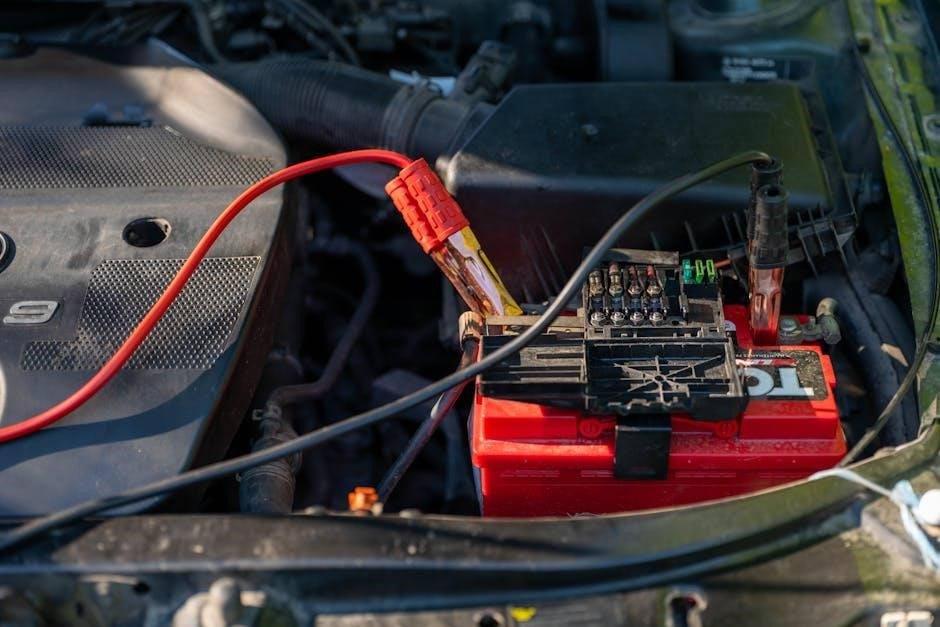
Low Voltage: Severely discharged batteries (below a certain voltage threshold, typically around 1.5V per cell) may not be recognized. Attempt to ‘jump start’ the battery briefly with another vehicle to raise the voltage slightly. Cable Integrity: Inspect the cables for damage – frayed wires or loose connections can prevent proper signal transmission. Try a known-good set of cables.
Battery Condition: A completely dead or internally shorted battery may also cause this issue.
Flashing Red Light – Error Codes
A flashing red light on your NOCO Genius charger signals an error condition requiring attention. The flash pattern indicates the specific problem. Slow Flash: Typically indicates a reverse polarity connection – immediately disconnect and re-attach the clips ensuring red is to positive (+) and black to negative (-).
Fast Flash: Often signifies a battery that is severely damaged, sulfated, or frozen. Do not attempt to charge a frozen battery. Alternating Flash: May indicate an over-voltage situation or internal charger fault. Disconnect the charger and contact NOCO support.
Continuous Flash: Suggests a low voltage battery that is too far discharged to be recognized. Attempt a brief jump start. Refer to the full error code list in the supplemental documentation for detailed explanations.
Maintenance & Storage
To ensure the longevity and optimal performance of your NOCO Genius charger, regular maintenance is recommended. Periodically inspect the charging cables and connectors for any signs of damage, such as fraying or corrosion. Clean the alligator clips and ring terminals with a wire brush to maintain a good electrical connection.
When storing the charger for extended periods, disconnect it from the power outlet. Store it in a cool, dry environment, away from direct sunlight and extreme temperatures. Avoid storing near flammable materials.
Wipe down the charger casing with a damp cloth to remove any dust or dirt. Do not immerse the charger in water or any other liquid. Proper storage will help preserve the charger’s functionality for years to come.
Technical Specifications (Voltage, Current, Battery Types Supported)
The NOCO Genius chargers are designed with versatile technical specifications to accommodate various battery needs. Input voltage typically ranges from 100-240V AC, 50/60Hz, making them suitable for global use. Output voltage varies by model, generally around 12V or 24V DC.
Charging current also differs; GENIUS10 offers up to 10 amps, GENIUS20 up to 20 amps, GENIUS35 up to 35 amps, and GENIUS50 up to 50 amps. These chargers support a wide array of battery types, including lead-acid, AGM, gel, and lithium-ion (LiFePO4).
They feature multi-stage charging and temperature compensation for optimal battery health. Refer to your specific model’s documentation for precise specifications.